Fast . Certified . Local Response
Structural drying removes the moisture trapped inside walls, floors, and framing after water damage, using air movers, commercial dehumidifiers, and daily moisture readings until your building reaches a dry standard. We provide professional structural drying services across Plano, Frisco, Allen, McKinney, and the surrounding Collin County area, for homes and commercial properties alike.Our IICRC certified team tracks every job with documented readings, not guesswork, and works directly with your insurance provider. Call now and we will start your drying plan today.
Getting the water out is only half the job. We dry what is left inside your structure, and we prove it with measurements, so mold never gets the damp conditions it needs.
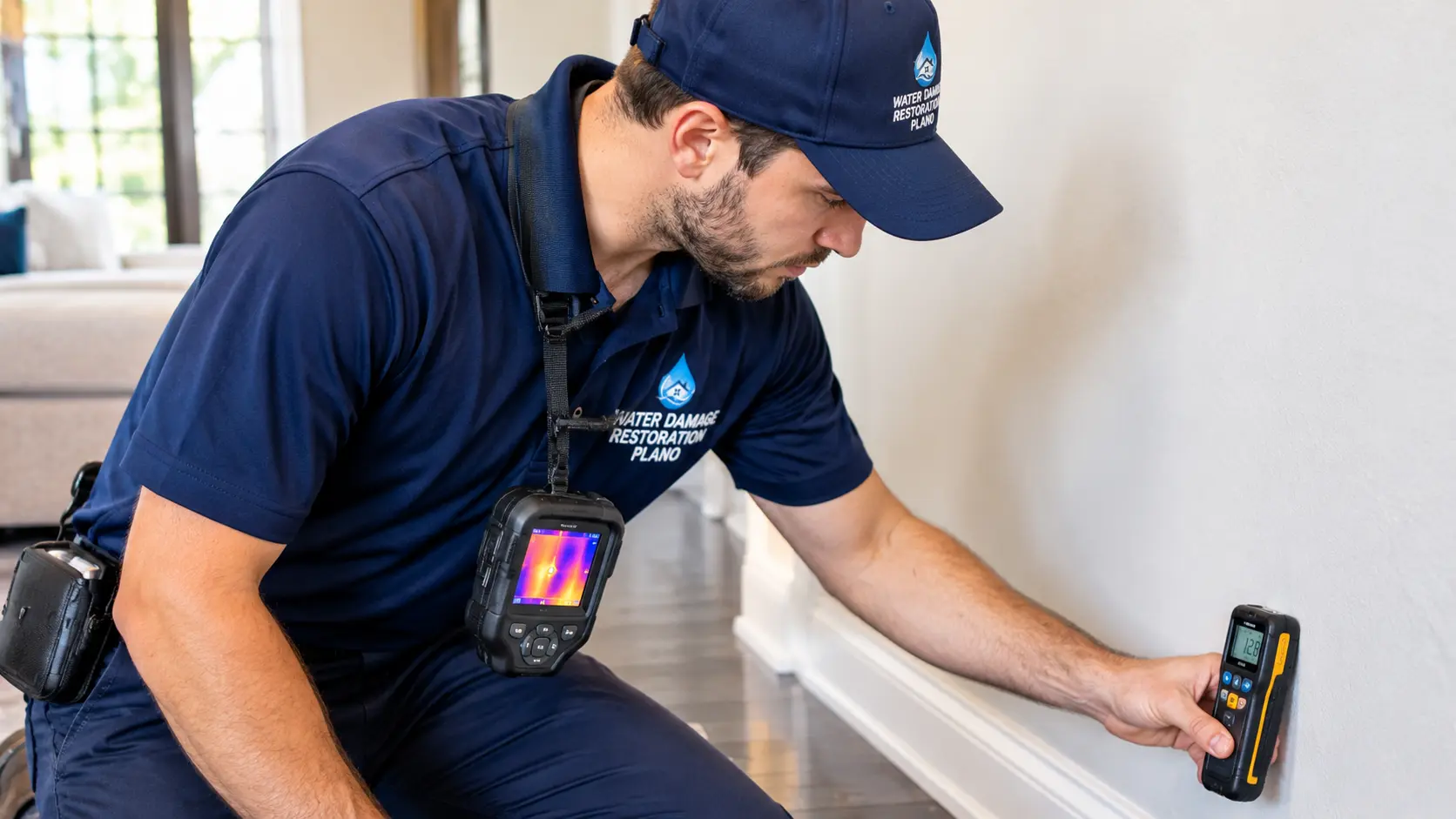
Most people picture a few fans in a wet room. Real structural drying is closer to managing a small, controlled climate inside your home.

No fine print. If a material is not dry to standard when we leave, we return and finish the job at no extra charge.
Dehumidification is one part of structural drying, not a separate service. Structural drying is the full process of drying a building’s materials. Dehumidification is the step that removes moisture from the air so the process keeps working.
Think of it as a sponge in a closed room. The wet materials are the sponge. Air movers help water leave the sponge and enter the air. Dehumidifier services then remove that water from the air. Without the dehumidifier, the room fills with moisture and the sponge stops drying. Fans alone can even push humidity into rooms that were dry.
That is why a store bought dehumidifier rarely finishes the job. A standard unit is not built to pull large volumes of moisture out of a structure, and it comes with no plan for placement, monitoring, or verification.
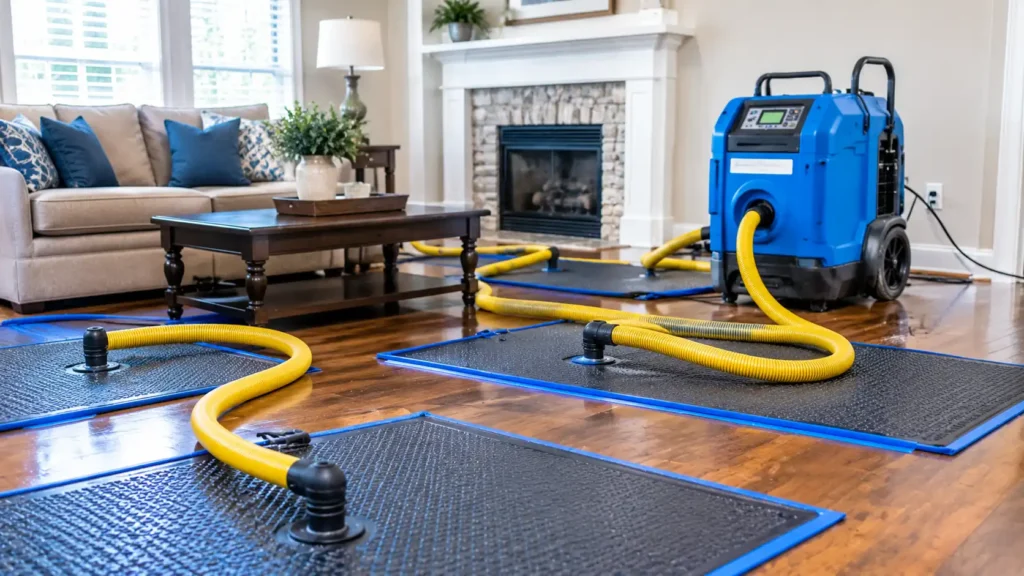
Meters and thermal imaging show where water traveled, including inside walls and under floors.
We classify the loss, set a drying goal from unaffected materials, and define the drying area.
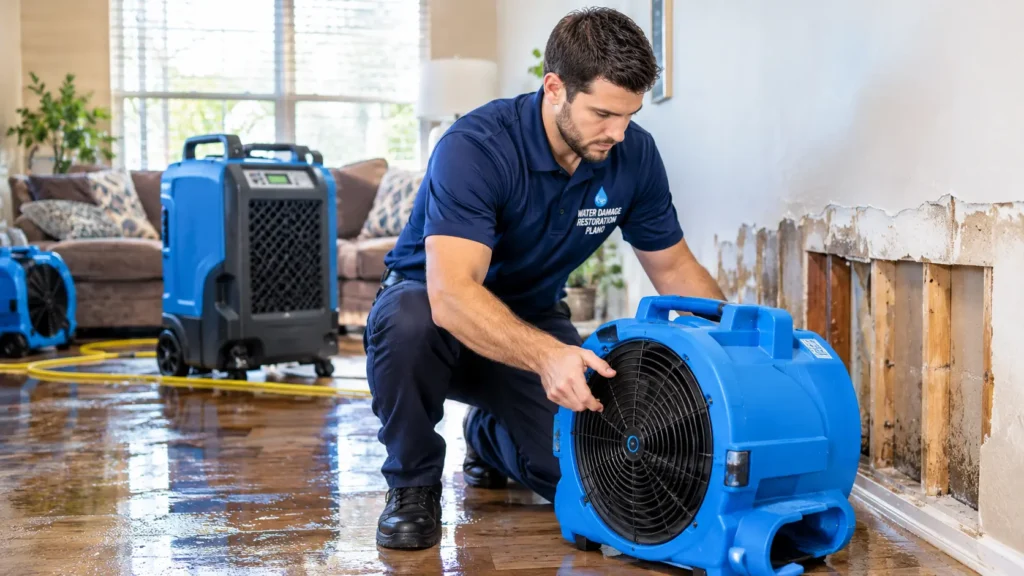
Air movers and dehumidifiers are sized to the affected space and the class of water damage, following ANSI/IICRC S500.
We record temperature, humidity, grains per pound, and material moisture every day, then adjust equipment.
Equipment stays until readings in wet materials match the goal and hold steady.
We remove equipment and give you the drying logs for your files and your insurer.
Professional structural drying services should come with proof, not just equipment. Here is what that looks like on our jobs.
We drive the process with readings, not a calendar guess about when it should be done.
Every visit is recorded, so you and your adjuster can see exactly how the drying progressed.
LGR dehumidifiers, desiccant units, and drying mats are matched to the material and the loss.
Thermal imaging and meters find water behind finishes before it turns into mold.

We provide structural drying services and dehumidification services across Plano, including West Plano, East Plano, Downtown Plano, Legacy West, Willow Bend, Deerfield, and Hunters Glen.
Our crews also serve
For offices, retail, restaurants, and multi unit properties, our building drying services are scheduled around your operations to limit downtime.
Drying logs are the paper trail behind a water damage claim. Adjusters commonly review daily readings, equipment placement, and drying time to understand why a job needed the days and equipment it did. We keep complete records for every structural drying service we perform and share them with you and your insurer, so the drying time is supported by data, not opinion.
Some losses call for more than fans and a dehumidifier. Advanced structural drying means choosing equipment and methods for the material that is wet.
The water you cannot see is the water that causes the damage. Within 24 to 48 hours, damp materials can support mold. Hardwood starts to cup, drywall softens, baseboards swell, and insulation holds water against framing.Warm, humid North Texas conditions speed all of this up. The longer materials stay wet, the more the job shifts from drying to demolition and replacement, so starting early is the cheapest decision you can make.
Questions Plano property owners ask us most about structural drying and dehumidification.
Most jobs take three to five days. Saturated hardwood, plaster, and concrete slabs take longer, and we confirm completion with moisture readings, not the calendar.
We compare moisture readings in the wet materials with a drying goal set from unaffected materials in your home. Equipment stays until those readings match and stay stable.
For a small, shallow spill, sometimes. Once water has reached drywall, insulation, or subfloors, household equipment usually cannot dry it fully, and trapped moisture leads to mold.
Look for IICRC trained technicians, a written drying plan, daily readings and logs, and a clear dry standard before equipment is removed. A company that cannot show readings cannot show the job is done.
Our service is professional drying after water damage or moisture intrusion, using temporary commercial equipment. For permanent home dehumidifier service, such as installation or repair of a whole house unit, an HVAC contractor is usually the right specialist.
Often yes for contained losses. The equipment is loud and uses real power, so some families sleep elsewhere. Sewage, mold, or heavy contamination may require leaving the affected area.
It is part of mitigation, which national guides put at roughly $3 to $7.50 per square foot, depending mainly on the water category. An on site assessment gives your actual number. See our water damage restoration cost guide for the full breakdown.
Yes. We offer building drying services for offices, retail spaces, restaurants, and multi unit properties across Plano and Collin County.
Every day wet materials stay damp raises the chance of mold and the size of the repair. Contact our team today for structural drying services Plano property owners can rely on, backed by documented readings and a crew that stays until your building is genuinely dry.