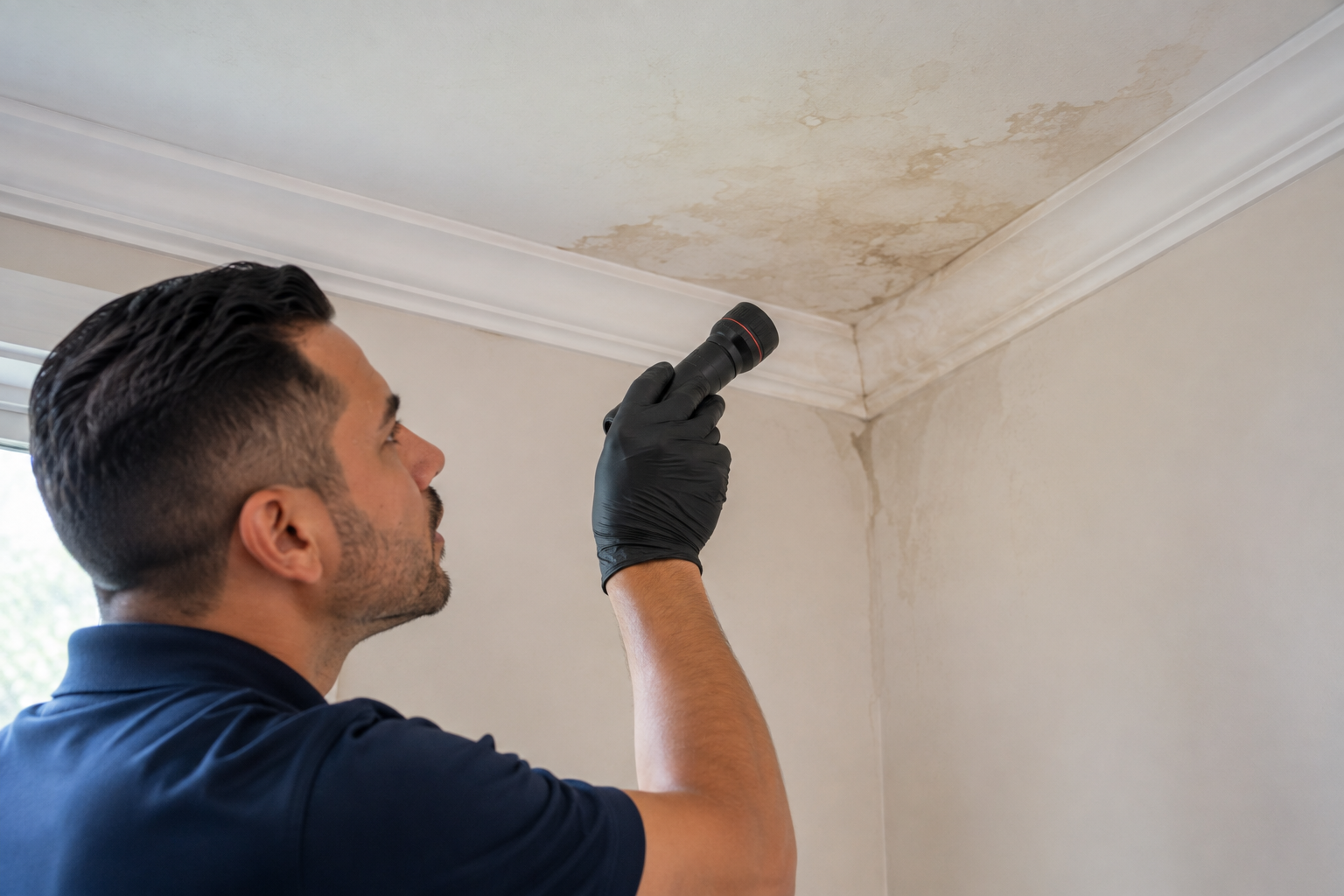
If your wall has a yellow or brown stain, feels soft or spongy when pressed, or the paint nearby is bubbling or peeling, you’re likely looking at water damage. These are the most common warning signs, but water damage in walls can also show up more quietly, as a musty smell or a slight change in texture, long before it becomes obvious to the eye.
Catching these signs early matters. Water sitting inside a wall cavity doesn’t just sit there, it spreads, weakens the material around it, and creates the exact damp conditions mold needs to start growing. The sooner it’s identified, the smaller and cheaper the fix tends to be.
The Most Common Signs of Hidden Water Damage in Walls
1. Discoloration and Staining
This is usually the first thing people notice. Water leaves behind yellow, brown, or copper toned stains as it dries, often in an irregular ring or blotchy shape rather than a clean edge. On darker walls, this can show up as a slightly darker, damp looking patch instead of an obvious stain.
2. Bubbling or Peeling Paint
Moisture breaks down the adhesive holding paint to a wall. When that happens, you’ll often see small bubbles forming under the surface, or paint that’s started to flake and lift away entirely. Wallpaper shows a similar reaction, bubbling and separating from the wall underneath.
3. A Persistent Musty Odor
A damp, musty smell in one specific area, especially if it doesn’t go away with normal cleaning, is one of the more reliable indicators something is happening behind the surface. This smell usually means moisture has been present long enough for mold or mildew to start developing, even if nothing is visible yet.
4. Soft, Warped, or Spongy Drywall
Press gently on a suspicious area. Drywall that’s absorbed water tends to feel soft or give slightly under light pressure, where a dry, healthy wall would feel firm and solid. Warping or a slight bulge outward is another version of the same problem.
5. Visible Mold Spotting
Small black, green, or dark spots, often appearing first near baseboards, corners, or around window and door frames, are a sign that moisture has been present long enough for mold to establish itself. Once mold is visible, the water damage behind it has usually been there for a while.
6. A Noticeable Change in Texture
Beyond softness, water damaged walls sometimes develop a slightly different texture altogether, a chalky feel on painted surfaces, or a grainy texture where drywall has started to break down internally.
Early Signs of Water Damage in Walls You Might Be Missing
Not every case announces itself with an obvious stain. Some of the earliest signs of water damage in walls are subtle enough that they get dismissed or overlooked entirely.
A musty smell with no visible source is one of the most common early indicators, and it’s also one of the easiest to ignore, since there’s nothing to actually point to. The same goes for a very faint, barely noticeable discoloration near a ceiling corner or along a baseboard, easy to write off as dust or normal wear until it grows larger.
Paint that feels slightly different to the touch, a little rougher, a little less smooth, than the surrounding wall, can also be an early clue, even before any visible bubbling starts. And a wall that feels cooler or slightly damp compared to the rest of the room, particularly in a bathroom or a wall that backs up to plumbing, is worth paying attention to rather than dismissing as normal.
Catching these early signs of water damage in walls before they progress to an obvious stain or soft spot is genuinely the difference between a minor repair and a much larger one.
Drywall Signs of Water Damage in Walls Specifically
Drywall reacts to water in a fairly predictable way, and knowing what that looks like helps you tell the difference between cosmetic wear and an actual moisture problem.
Sagging is one of the clearest drywall specific signs of water damage in walls, a section that’s begun to droop or lose its flat, rigid shape has absorbed enough water to weaken its internal structure. Seams between drywall panels can also start to separate or become more visible as the material swells slightly and shifts.
Screws or nails holding drywall in place sometimes start to pop out slightly, or small cracks form radiating outward from a screw point, both signs that the board behind the surface has softened. In more advanced cases, drywall can actually begin to crumble at the edges when touched, at which point replacement, not just drying, is usually necessary.
What Causes Water Damage Behind Walls
Understanding the cause helps make sense of where to look. A handful of sources account for most cases.
Plumbing leaks hidden inside wall cavities are one of the most frequent causes, a slow drip from a pipe joint can go unnoticed for weeks since it’s not visible and often not dramatic enough to cause an immediate flood.
Roof leaks don’t always show up where the water enters. Rain can travel down along framing and studs, appearing as a stain on a wall well below and away from the actual point of entry on the roof.
Bathroom caulking and grout failure is a quieter, slower version of the same problem. Once the seal around a tub or shower breaks down, water works its way behind tile and into the wall over time, often for months before it’s noticed.
HVAC condensation can also be a culprit, particularly around ductwork or units installed inside a wall cavity, where consistent moisture buildup mimics a slow leak.
Foundation and slab related moisture rounds out the list, water finding its way up through a slab or foundation crack can wick into the base of a wall, usually showing up first as damage near the floor rather than higher up.
Why These Signs Matter
It’s tempting to treat a small stain or a faint smell as a cosmetic issue to deal with eventually. That’s usually a mistake.
Water sitting inside a wall doesn’t stay contained, it continues to spread through the material and into anything it touches, insulation, framing, adjacent drywall. Left long enough, this weakens the structural elements of the wall itself, not just its appearance. Indoor air quality is also affected, since damp building materials are a leading contributor to mold growth and the health issues that come with it, from allergy symptoms to more serious respiratory concerns for sensitive individuals.
There’s also a straightforward financial angle. A small water stain caught early might mean a patch and repaint. The same problem ignored for six months can mean replacing entire sections of drywall, dealing with mold remediation, and in some cases addressing weakened framing underneath.
How Professionals Confirm Water Damage in Walls
A visual inspection only tells part of the story, which is why professionals typically use a couple of specific tools to see what’s actually happening beneath the surface.
A moisture meter measures the actual water content inside a wall, giving a concrete reading rather than a guess based on appearance alone. Thermal imaging cameras go a step further, detecting temperature differences that often indicate moisture even in areas that look completely normal to the eye. Together, these tools can map the full extent of a problem without needing to cut open the wall first, which matters both for accuracy and for minimizing unnecessary damage during the inspection itself.
What to Do If You Notice These Signs
If you’ve spotted one or more of these signs, a few steps are worth taking right away.
Don’t cut into the wall yourself before understanding the scope, doing so can spread mold spores if they’re present, and it often causes more damage than it reveals useful information. If you can identify an obvious active leak, shutting off the water supply to that area is worth doing immediately, even before anyone arrives to assess it.
Take photos of the affected area as soon as you notice it, this is useful both for tracking whether it’s getting worse and for any insurance documentation that might be needed later. Avoid simply painting over a stain without addressing what caused it, this hides the visible sign without solving the underlying moisture problem, which almost always continues.
When to Call a Professional
A small, isolated stain that isn’t growing might be worth monitoring for a short period. But if you’re seeing more than one sign at once, a stain paired with a musty smell, or soft drywall alongside visible mold spotting, that combination usually means the moisture problem is more established than it first appears.
The same goes for any sign larger than roughly a hand sized area, or one located near a known plumbing line, bathroom wall, or exterior wall that’s taken water exposure before. In these situations, a professional inspection with proper moisture detection tools is worth the call, rather than waiting to see whether it resolves on its own, since water damage inside a wall essentially never does.
Frequently Asked Questions
How long does it take for water damage to show up in a wall?
It varies widely depending on the source. A significant leak can show visible signs within a day or two, while a slow, minor leak might take weeks or even months to become noticeable.
Can water damage in a wall dry out on its own?
Surface moisture can dry, but water trapped inside a wall cavity, insulation, or behind drywall usually needs active drying equipment to fully resolve, otherwise it tends to remain damp long enough for mold to develop.
Is it safe to live in a home with water damaged walls?
Minor, contained water damage isn’t typically an immediate safety issue, but any mold growth, structural softening, or damage near electrical wiring should be addressed before it’s considered fully safe.
Do all signs of water damage in walls mean I need professional help?
Not always, a very small, isolated, and clearly resolved incident, like a one time spill that dried quickly, may not need intervention. Ongoing or unexplained signs, however, generally warrant a proper inspection.
If You’re Seeing These Signs Now
Recognizing the signs is the first step, addressing the source is what actually stops the damage from continuing. If you’re noticing discoloration, a persistent musty smell, or soft spots in your walls, a professional inspection using moisture meters and thermal imaging can confirm exactly what’s happening and how far it’s spread, without unnecessary demolition to find out. Our certified team provides water damage inspection and restoration services, and can help you understand exactly what you’re dealing with before it becomes a larger problem.